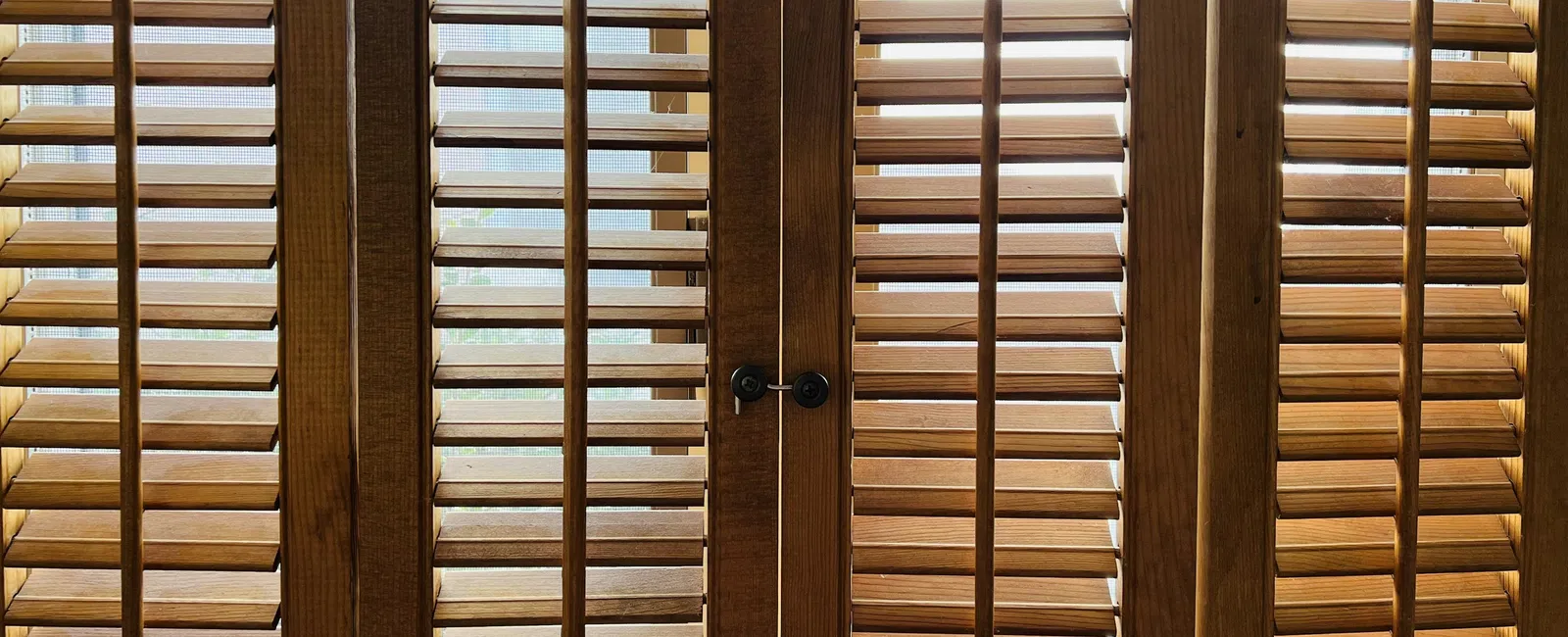
A plantation shutter is fastened into the window frame and stays with the house when it sells. A blind hangs from a headrail on two brackets and comes down in about ninety seconds with a screwdriver. Everything else that separates these two products, including the price gap, the way each one handles a July afternoon in Dallas, and how they look from the street, follows from that one structural difference.
What Separates A Shutter From A Blind
Shutters are built as a framed panel with fixed louvers on a hinge. The frame mounts into or over the window opening and the panels swing on it. Louvers come in several widths, and the wider ones give a cleaner view line and a more open feel when tilted, while narrower louvers read as more traditional. Nothing raises or lowers. You tilt the louvers, or you swing the panel open.
Blinds are horizontal slats on a ladder cord or tape, hanging from a headrail. Cordless versions tilt with a wand and lift with a spring mechanism, so the whole stack can raise clear of the glass. That ability to fully clear the window is the practical thing a shutter cannot do.
The material differs as well. Plantation shutters come in premium wood and composite with paint and stain finishes matched to existing trim. Faux wood blinds use a composite built to resist warping and fading in heat and humidity, in white, off-white, and wood tones.
The Cost Difference And What You Get For It
Shutters and faux wood blinds sit at different price points, and the difference reflects what goes into each one. A shutter is a custom-built frame with hardwood or premium composite panels, finished to match existing trim and fitted into the opening so it becomes part of the window. Homeowners who choose them usually weigh that cost against built-in cabinetry or a quality front door rather than against another window covering, since it stays with the house and keeps working for decades.
Blinds sit at a friendlier price per window and go in faster, which makes them a practical way to cover a house all at once, outfit a rental, or handle rooms where the window covering is doing a job rather than making a statement. Pricing quoted per window installed rather than as a single figure makes it easy to see how the two compare room by room, and mixing them across a house is common.
How Each One Handles Texas Heat
Closed shutter louvers form a solid panel of wood or composite across the glass with the frame sealed into the opening. That construction insulates better than a slatted blind, because a blind leaves small openings along every slat even when tilted fully closed. On a west-facing window in a DFW summer, the difference shows up in how warm the room feels at five in the afternoon and in how hard the air conditioner works to keep up.
Faux wood blinds still block direct sun well and resist the warping and fading that heat and moisture cause in real wood. They just do not seal an opening the way a shutter frame does.
Light Control And Privacy Differences
Shutters give precise louver control and full privacy when closed, with no cords anywhere. Blinds tilt for light and lift completely out of the way, which shutters cannot match on a window where you want the whole opening clear.
Neither product delivers true darkness. If a bedroom or media room needs the sun gone, that calls for room darkening roller shades, which block up to 90 percent of incoming light, or a set of blackout drapery panels layered over whatever hard treatment is already there.
Where Shutters Earn The Extra Cost
Front-facing windows are the clearest case. Shutters look uniform from the street in a way that blinds do not, and that uniformity is what buyers and appraisers respond to. Living rooms and primary bedrooms are the next tier, since those are the rooms people spend time in and the ones shown first.
Specialty openings make shutters the practical answer rather than the premium one. Arches, angled tops, French doors, and sliding glass doors all take custom-built shutters that fit shapes standard coverings cannot cover cleanly.
Anyone planning to stay in the house for a decade or more gets the most out of the investment, because a shutter installed correctly lasts as long as the window does.
Where Blinds Make More Sense
Kitchens, bathrooms, and laundry rooms take steam, splatter, and daily handling, and a faux wood blind wipes clean with a damp cloth. Family rooms with kids and pets benefit from a cordless lift and a treatment that costs little to replace if it gets abused. Rentals and offices need something that looks finished without the budget of a permanent upgrade. Windows you want fully clear at times, such as one over a sink or facing a view, favor a blind that lifts away.
What To Check On Each Window Before You Decide
Walking the house with a few specific things in mind narrows the answer faster than comparing the two products in the abstract. On every opening, note the following:
- Whether the window faces the street and is visible from the curb
- Which direction it faces, since west and south exposures take the worst afternoon heat
- Whether the opening is rectangular or an arch, angle, or door
- How often you want the window fully uncovered
- Whether the room takes steam, splatter, or heavy daily handling
- How much frame depth the opening has for a shutter frame to land in
- Whether the room needs real darkness for sleep or screens
- How long you plan to stay in the house
How We Sort It Room By Room
Most houses end up with a mix. Shutters on the front elevation and the main living space, blinds in the wet rooms and the back of the house, and roller shades wherever glare or sleep is the real problem. We measure every opening, tell you which rooms justify the upgrade and which ones do not, and leave you with a written quote instead of a number guessed on the phone.
Call us at (214) 934-2479 to set up a free in-home consultation in Dallas, Fort Worth, Plano, Frisco, or the surrounding areas. We bring the samples so you can see the finishes against your own walls and floors.