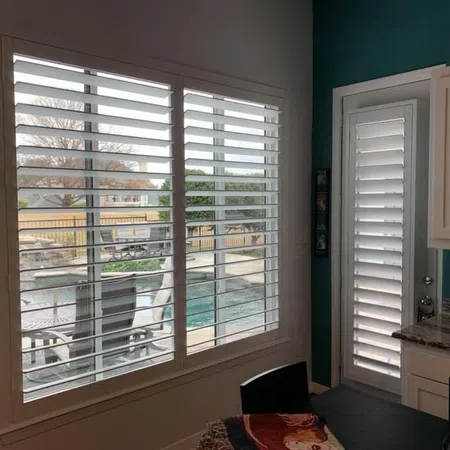
Faux wood blinds are made from a composite that looks like painted or stained wood but holds its shape in humid rooms and strong sun. Real wood blinds are lighter and carry natural grain that a composite can only imitate, but steam and heat can warp or fade them. For kitchens, bathrooms, laundry rooms and any window that takes afternoon sun, faux wood is the better choice. Real wood suits dry rooms where the grain is the point.
What Faux Wood Blinds Are Made Of
Faux wood blinds use a moisture-resistant material, either solid vinyl or a composite, shaped and finished to look like a wood slat. The 2-inch cordless faux wood blind we install is a durable composite, offered in white, off-white, and popular wood tones. It raises with a cordless lift and tilts with a wand, so there are no dangling cords at the window.
Real wood blinds are cut from thin hardwood slats, then stained or painted. Because the slat is actual wood, the grain changes from one slat to the next, and a stain shows real depth.
You will also see vinyl blinds sold beside faux wood. Both resist moisture. The difference shows in how solid the slat feels in your hand and how convincing the finish looks, which is easiest to judge with samples side by side at the window.
How Wood and Faux Wood Blinds Compare
Across a room, the two look alike. The differences show up after a few years of steam, sun, and daily use.
Humidity and Steam
Real wood absorbs moisture from the air. In a bathroom after daily showers, or above a kitchen sink, wood slats can bow or warp, and a warped slat does not go back to straight. Faux wood is moisture-resistant, so steam and splatter leave its shape alone. That single difference is why faux wood blinds became the standard choice for wet rooms.
Sun and Heat
A window that takes hours of direct sun is hard on any finish. Over time, real wood can fade and dry out, and a dried slat is more likely to crack. Faux wood is engineered to resist warping, fading, and cracking in high heat, so a sunny window still looks right years later.
Weight and Window Width
Faux wood slats are heavier than real wood. On an average bedroom window, you will not notice. On a very wide window, the full stack carries more weight every time you raise it, which is where real wood's lighter slat earns attention. During the in-home measure, we check each window's width and how often you plan to raise the blind, and we talk through the best operation for large or hard-to-reach windows.
Cleaning
Faux wood wipes clean with a damp cloth, with no special cleaners or careful handling. Real wood should stay dry, so it gets dusted or cleaned with a product made for wood finishes.
The Look Up Close
From across the room, a well-made faux wood blind reads as painted or stained wood. At arm's length, real wood shows grain variation that a molded slat does not fully match. If a stained blind is the focal point of a formal room you sit in every day, you may notice. In white or off-white, the difference mostly disappears.
Rooms Where Faux Wood Is the Better Pick
Faux wood belongs anywhere a window covering takes moisture, sun, or a lot of handling. In most houses, that covers more rooms than not:
- Kitchens, where steam, cooking splatter, and a window over the sink are daily conditions
- Bathrooms, where humidity after every shower would work on real wood
- Laundry rooms, for the same reason
- Any window that catches direct afternoon sun
- Family rooms and kids' rooms, where a cordless lift keeps cords out of reach of children and pets
- Rentals and offices that need a finished look on a practical budget
When Real Wood Still Makes Sense
Real wood is a fair choice in a dry, climate-steady room with little direct sun on the glass, such as a study, dining room or formal living room. Its lighter slats also help on very wide windows that get raised every day. If you love stained wood and the room treats it gently, real wood will serve you well. It asks for a little more care and the right room.
If what you want is a wood look that becomes part of the window, plantation shutters are worth comparing too. They are built into the frame and finished to match your trim, which puts them in a different category from either blind.
Questions to Answer Before You Choose
Walk through the house with these in mind, and most windows sort themselves out:
- Does the room get steam, splatter, or high humidity?
- Does the window take direct sun for much of the day?
- How wide is the window, and how often will you raise the blind?
- Will children or pets spend time near the window?
- Is the blind a backdrop, or the focal point of the room?
A yes to the first, second, or fourth question points to faux wood. A wide window you raise daily, or a stained blind that anchors a formal room, is where real wood earns a closer look.
How We Help You Decide
At the in-home consultation, we bring samples, so you can see white, off-white, and wood tones against your own trim and floors instead of on a screen. We measure every window, point out the ones that are wide or hard to reach, and tell you which rooms need what. Custom measuring and professional installation are included with every faux wood blind order, so getting the fit right is our job.
Some windows need more than a blind. A bedroom or media room that needs real darkness is better served by room-darkening roller shades, and draperies layer well over blinds when you want softness and extra coverage. You can see finished installs in our image gallery.
Request an in-home consultation, and we will measure every window and help you match each room to the right blind.